
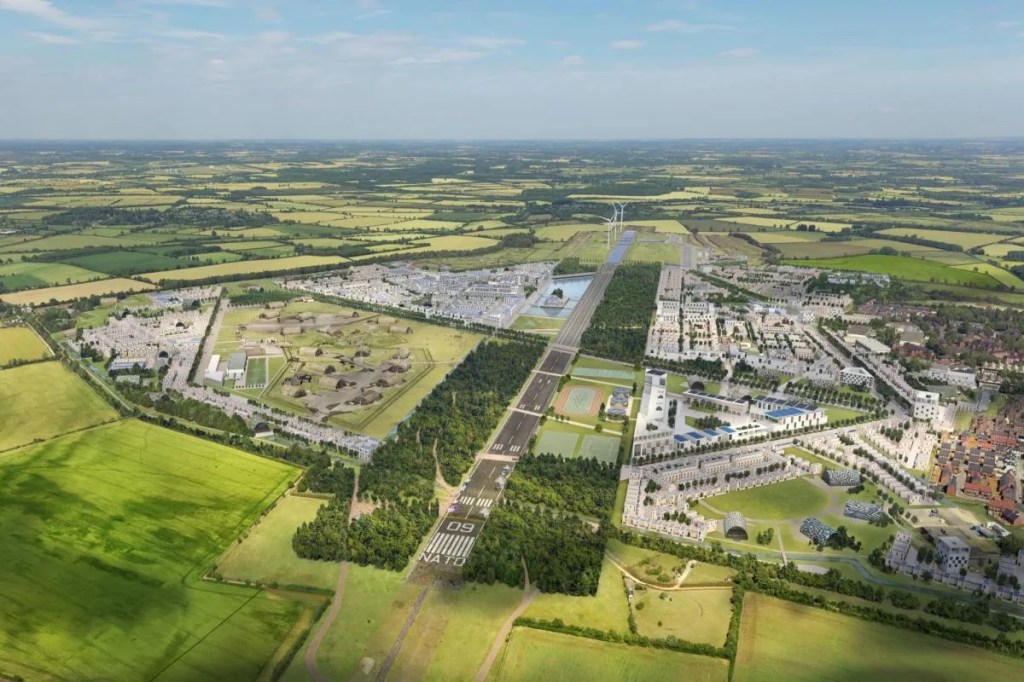
A week ago the news broke that the proposed Heyford Park development of 9 to 13,000 new homes will not be a designated New Town. Dorchester’s plans do not have government backing, and will not benefit from government funding either.
For locals opposing the plans in their current form this is very good news because it means the application has been ‘downgraded’ to a local authority planning application: it will be dealt with by Cherwell District Council (CDC) instead of central government.
This is important news. Aside from the gloss that being on the New Town shortlist afforded the developers, in recent weeks we have also seen hastily compiled, speculative ‘add-on’ developments being submitted (hello Richborough). This loss of prestige will certainly be felt beyond Dorchester and their investors.
What it really means
More important than this PR disaster for Dorchester is the fact that the process of challenging the shortcomings of the Heyford Park proposals is more straightforward. Objectors will be now dealing with the local authority’s planning process, and that is always preferable to taking on the government’s much more complex planning processes.
Key issues with the proposals
Dorchester’s environmental impact assessment (EIA) must set out how the development is going to affect the proposed site and neighbouring areas. These impacts include drainage and flooding; noise, light and air pollution; climate risk and habitats, but also the impact on the local heritage, ancient woodlands and archaeology in the area. Dorchester’s proposals have been found seriously flawed in just about all of these areas by the government’s Ministry of Housing, Communities and Local Government.
The Strategic Environmental Assessment (SEA) published earlier this month identifies various significant issues with the Heyford Park proposals, which ultimately led to it being dropped from the shortlist. The SEA reviewed the Heyford Park proposals by scoring the proposal on key objectives and considering the impacts over the short term (0 to <5 years), medium term (5-25 years) and long term (25+ years). It then scored each topic as being compatible, neutral, uncertain or incompatible with New Town objectives.
Here we pick out just half a dozen of the issues NORA has identified in this 500+ page report. In no particular order:
Issue 1: the development is disproportionately large
The impact of 9 to 13,000 new dwellings and their supporting infrastructure is disproportionately high as a result of the small existing population at Heyford Park (Table D-18, p. 202).
Issue 2: water supply
Serious water stress is mentioned by the Environment Agency (p.204) and the report is uncertain whether there are sufficient water resources to meet increased demand (p. 494).
Issue 3: poor air quality for decades
Air quality is assessed as having a significant negative effect on Air Quality SEA objective in the next 25 years, after which Heyford Park is thought to have only a ‘minor positive’ impact on air quality. (p.472).
Issue 4: car dependency
Uncertainties about the scale and type of public transport available to Heyford Park and the potential for high car dependency have not helped its case (p.473).
Issue 5: negative impact on historic environment
Historic England have made specific references to the scheduled monuments, conservation areas and Rousham, and the SEA reflects this with a low score for Historic Environment.
Issue 6: coalescence and loss of identity
Coalescence with nearby settlements is referenced as a serious problem (p.491):
Nearby existing communities such as Caulcott, Lower Heyford and Upper Heyford are most likely to be impacted by the development of a new town in this broad location. There is a risk that the identity of these communities could be lost without sensitive planning and suitable open and green space provided between new development and these existing communities.
What happens next?
As this is now a CDC planning matter, the Heyford Park proposals will be dealt with by our local planning authority. A planning decision will be made by the CDC Planning Committee. A date for this has not been set.
This means that you can continue to submit responses to the proposals, which is especially important if you have not yet done so.
How to respond to the Heyford Park proposals
Send your objection to planning@cherwell-dc.gov.uk as an email, or with a separate document with your objection.
Send by post to Cherwell District Council, Planning Team, 39 Castle Quay Banbury Oxon OX16 5FD
Please ensure you include the relevant reference number, 25/02190/HYBRID, your name, and your full address. Without these, your objection will not be accepted.
The planning portal is known to crash and lose submissions. If you do use the portal to object, NORA recommends checking later to verify whether your objection has been recorded and published.
Sign up to our updates
As planning applications move through the different stages to approval/rejection, new documents are added to existing ones in response to statutory consultees’ contributions. When new details emerge on any application, local residents can submit additional responses specifically about this new information.
In short, as new information emerges about applications, locals have new opportunities to object again in addition to earlier objections.
To stay informed on new developments on this and other planning applications, sign up to our updates – you can unsubscribe anytime.
 NORA North Oxfordshire Resident Action
Leave a comment